At the Global Retail Banking Innovation Summit 2026, industry leaders from Trust Bank and HSBC explored how banks can move beyond transactional rewards to build lasting customer relationships. From stock-based rewards to AI-powered personalisation and ecosystem partnerships, the discussion revealed why the future of loyalty lies in understanding customers’ financial aspirations, not simply rewarding their spending.
The most significant changes in retail banking are not always the ones customers immediately notice. Payments, cards and rewards remain everyday features of banking, but their role is evolving as banks seek to transform routine transactions into meaningful, long-term customer relationships.
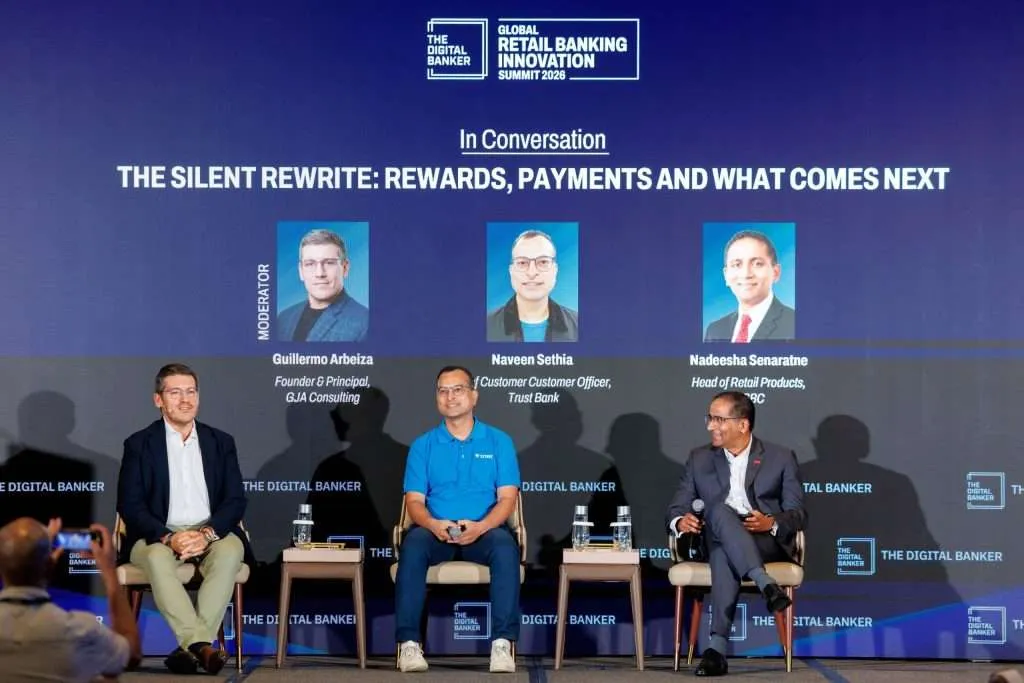
At The Global Retail Banking Innovation Summit 2026, a panel titled The Silent Rewrite: Rewards, Payments and What Comes Next examined the role of rewards and payments in customer loyalty. Moderated by Guillermo Arbeiza, Digital, CX & Data Advisor and Founder & Principal of GJA Consulting, the discussion featured Naveen Sethia, Chief Customer Officer at Trust Bank, and Nadeesha Senaratne, Head of Retail Products at HSBC.
Beyond points and cashback
Traditional rewards programmes have typically relied on airline miles, cashback and points to encourage spending. However, as customer expectations evolve, banks must reconsider whether these incentives create genuine loyalty or merely encourage short-term transactions.
Sethia illustrated this shift through Trust Bank’s Stockback programme, which allows customers to earn stocks through card spending. The initiative connects everyday payments with investing, making fractional stock ownership more accessible to customers who might otherwise face barriers to entering the market.
“We looked at all of them, and recently we launched a new reward programme. It’s a first in market where clients can use their card the way they wanted, but in return, they get stocks,” Sethia explained.
The approach reflects a broader opportunity to make rewards more tangible and aspirational, connecting everyday spending with customers’ longer-term financial goals.
Personalisation with purpose
For Senaratne, sustainable loyalty requires more than attractive incentives. Banks must deliver relevant experiences that build trust and demonstrate an understanding of individual customer needs.
“Rewards can buy a transaction. But what is more important as we think of loyalty, most important things are the trust, the relevance, the recognition that we have clients, and also the experiences,” he said.
Artificial intelligence (AI) and customer data can help banks move beyond generic offers towards more personalised engagement. Rather than simply recommending another product, institutions can use transaction patterns and digital interactions to identify customer needs and provide timely, meaningful support.
Senaratne emphasised the importance of understanding customers’ underlying motivations, explaining that “predicting client intent becomes absolutely important” to building stronger relationships.
Sethia echoed this view, cautioning that personalisation must genuinely benefit customers rather than serve as a vehicle for cross-selling. By interpreting signals such as customers creating savings goals within banking apps, institutions can better understand financial aspirations and tailor their support accordingly.
Building loyalty through ecosystems
Partnerships offer another way to differentiate rewards while extending value beyond traditional banking products.
Senaratne highlighted collaborations spanning healthcare and longevity, demonstrating how banks can support customers’ broader lifestyle and financial priorities. Sethia pointed to Trust Bank’s partnership with FairPrice, which connects everyday grocery spending with savings through its banking proposition.
As Sethia explained, customers appreciate the simplicity of receiving greater value from activities they already undertake: “They’re still doing the same thing they like to do. In this case, buying groceries. But if they’re using Trust Card, they’re saving more compared to using any other card they’re using to do the same activity.”
The panellists agreed that loyalty is no longer simply about offering bigger incentives. It is about integrating banking into customers’ everyday lives, anticipating their needs and delivering benefits that matter.
As the moderator Arbeiza concluded, “This is a long-term game.” For banks, the challenge ahead is to combine frequent payment interactions, meaningful rewards and intelligent personalisation to build relationships grounded in trust, relevance and lasting value.