

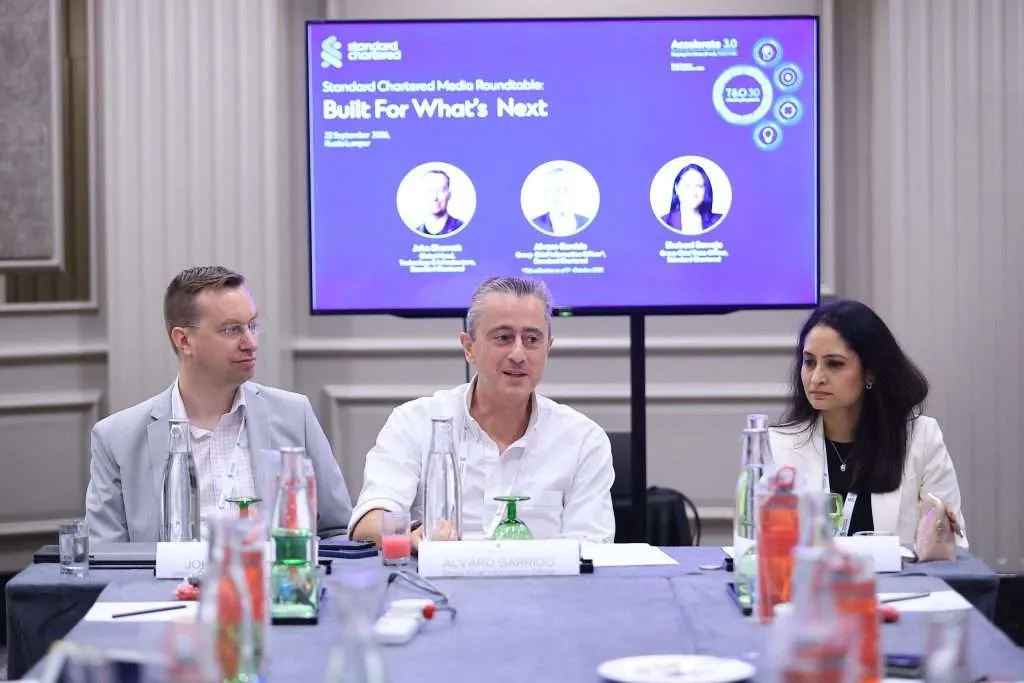
Standard Chartered is shifting its artificial intelligence (AI) strategy from experimentation to enterprise-wide execution, signalling a broader transformation that reaches beyond new technology into the bank’s operating model, data architecture and infrastructure.
At its Accelerate 3.0 media roundtable in Kuala Lumpur, Malaysia, three senior technology leaders outlined how the bank is building the foundations to deploy AI responsibly across its global business, with a clear focus on trusted data, resilient infrastructure and workforce readiness. Rather than positioning AI as a standalone innovation initiative, Standard Chartered is embedding it into the way the bank operates across 55 markets, aiming to become a simpler, faster and more connected organisation.
Alvaro Garrido, incoming Group Chief Information Officer (CIO) of Standard Chartered effective from 1 October 2026, said the bank’s latest organisational changes are designed to accelerate that vision. “What’s becoming increasingly clear is that success doesn’t come from technology alone. It depends on the strength of the foundations beneath it: the quality of our data, the resilience of our infrastructure, the effectiveness of our governance and, most importantly, the capabilities of our people,” he said.
The bank has already laid the groundwork through a single Enterprise AI Platform, known internally as the AI Factory, alongside a unified global data architecture, AI-supported payment operations, GenAI Concierge and enterprise-wide deployment of Microsoft Copilot. Garrido stressed that AI’s role is to automate routine work and surface better insights, allowing employees to spend more time on judgement-led decision-making and client engagement rather than repetitive tasks. He also pointed to Malaysia’s Capability Centre as a strategic hub delivering technology, cyber, operations, data, risk and compliance capabilities that support the bank’s global technology agenda.
While AI may be the headline technology, Shebani Baweja, Group Chief Data Officer argued that data is the real competitive differentiator. To support enterprise-scale AI, the Bank is consolidating more than 150 disconnected data systems into a single Global Data Supply Chain by the first half of 2028, creating one trusted source of truth across markets and business lines.
At the same time, governance is being redesigned to enable innovation rather than slow it down. Around 80% of risk controls are now codified, while 90% of key controls are continuously monitored through automated AI guardrails, allowing lower-risk use cases to move faster while maintaining stricter oversight for client-facing applications. Baweja said the approach has already delivered 95% data accuracy in AI-powered document processing, demonstrating that speed, governance and control can coexist.
For John Sharratt, Global Head, Technology & Infrastructure, Standard Chartered, scaling AI is ultimately an infrastructure challenge rather than a model challenge. He argued that the real barrier for global banks is no longer identifying AI use cases but creating a technology environment that can deploy them securely, consistently and economically across multiple jurisdictions.
The bank’s cloud strategy reflects the realities of global banking, where data sovereignty, regulatory requirements and cyber resilience vary across markets. Instead of moving large volumes of sensitive client data to AI models, Standard Chartered is bringing AI capabilities closer to where data already resides. Sharratt said this approach reduces complexity, strengthens security and creates a more cost-effective foundation for enterprise AI, while ensuring the bank can continue to meet local regulatory obligations.
A major focus is standardisation. Rather than building bespoke infrastructure for different regions, the bank is deploying pre-configured technology “racks” that operate under the same security controls, governance standards and operating model regardless of location. This creates a common platform that can be replicated across major data centres and smaller, highly regulated markets alike, enabling faster deployment of new AI capabilities without rebuilding infrastructure for each market. “That’s why we’re focused on finding “commodity AI” – making AI scalable, repeatable and cost-effective enough to support a much broader range of use cases across the Bank,” he said.
As banks race to embed AI across products, operations and client experiences, Standard Chartered is focusing on strengthening its data, governance, infrastructure and talent foundations to scale AI securely and consistently across its global network.