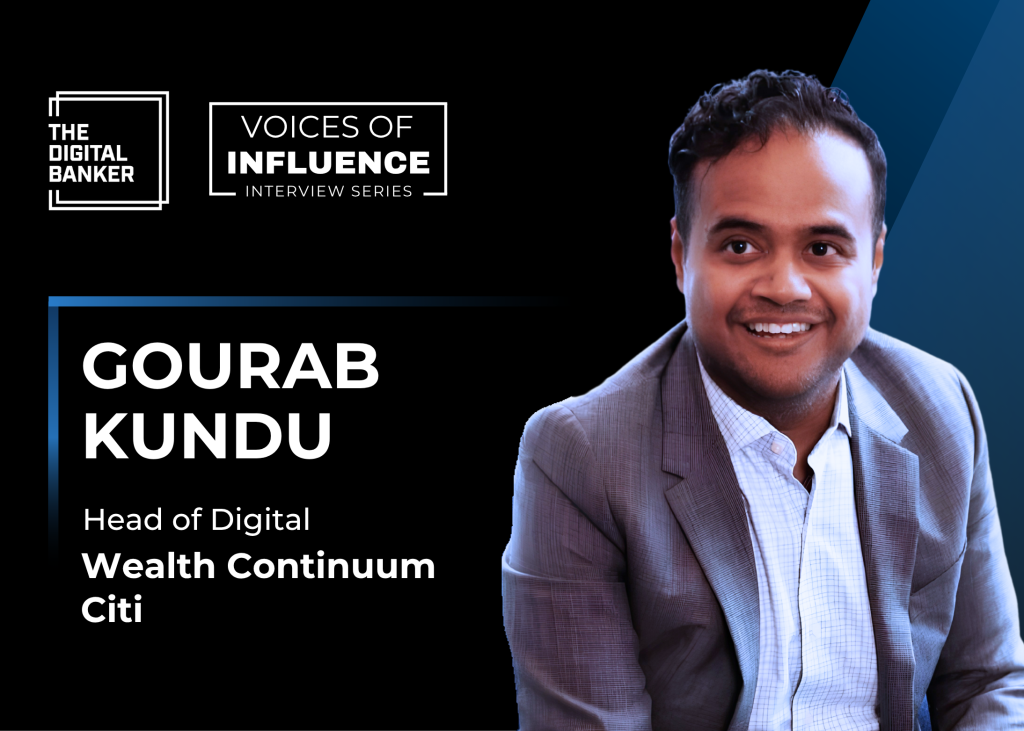
In an interview with The Digital Banker, Gourab Kundu, Head of Digital, Wealth Continuum at Citi, discusses why digital wealth transformation goes beyond introducing new technology. He explains how banks can simplify client experiences, remove friction and deliver more personalised services while preserving the human judgement and trust that wealth management demands.
For Gourab Kundu, Head of Digital, Wealth Continuum at Citi, the success of digital transformation comes down to a simple question: does it make life easier for clients?
“Digital launches are not the objective; delivering a superlative and frictionless client experience is,” he says.
That distinction captures Citi’s approach to digital wealth management. Rather than treating technology as an end in itself, the bank focuses on how digital capabilities can simplify the client journey, support better decisions and strengthen relationships built on trust.
For Kundu, that relationship begins with trust.
“Trust is the most important currency in wealth management,” he says. “Every client experience and interaction must reinforce that trust while making life simpler for clients and enabling our employees to serve them more effectively.”
This is where wealth management differs from many other areas of banking. Clients expect the speed and convenience they experience elsewhere in their digital lives, but they also want to know that someone understands their financial circumstances and can guide them through important decisions.
Technology can make the journey smoother. It cannot, on its own, provide that reassurance.
Starting with the client, not the technology
Over the past year, Citi’s thinking around digital transformation has centred on a fundamental question: does an existing process need to be digitised at all, or should it be reconsidered from the beginning?
“True transformation starts with challenging assumptions, not implementing technology”, says Kundu
The distinction matters because digitising an inefficient process does little to improve the underlying experience. Citi’s approach, he explains, involves looking at the client journey first, identifying where friction occurs and then determining how best to address it.
Sometimes, the improvement comes down to a seemingly small change. Real-time deal booking, for instance, reduces waiting and uncertainty. In-app chat when a suspicious transaction occurs gives clients a direct way to seek help when they may be anxious about the security of their money.
Neither example needs to be particularly elaborate to make a difference. The value lies in addressing a specific need at the moment it arises. This is also a more meaningful way to assess digital progress. Rather than counting launches or measuring success solely through adoption, Citi can focus on whether its capabilities solve problems that clients actually encounter.
Giving advisers more room to advise
Artificial intelligence adds another dimension to this approach. Its potential in wealth management extends beyond automating tasks, particularly when it can help advisers make better use of information and spend more time with clients.
“At Citi, we believe that AI should augment our advisors’ expertise with data-driven insights, freeing them to focus on building deeper, more personalised client relationships,” Kundu says.
Consider the demands on a wealth adviser managing clients with different financial priorities, investment horizons and family circumstances. AI can help process information, surface relevant insights and reduce administrative work. That gives advisers more time to understand what matters to each client and discuss the decisions ahead.
Yet there are limits to how far technology should take over. “Wealth management remains fundamentally a relationship business,” he says. “Trust, judgement and accountability cannot be automated.”
That distinction will matter as AI becomes more capable. The objective is not to replicate the adviser-client relationship through technology, but to give advisers better tools to support it. In a business built on long-term relationships, the human element remains central to the value clients receive.
One relationship across every channel
The way clients manage their wealth also continues to evolve. Their needs may span everyday banking, investments and advisory services, while financial decisions can involve several generations of a family. A fragmented experience, where information and interactions feel disconnected, can make an already complex relationship harder to manage.
Citi wants clients to experience “one connected relationship, not a collection of products or channels”. Achieving that means making interactions more relevant and ensuring that digital services work together with human advice. Clients should be able to move between channels without feeling that they are starting over each time.
Personalisation has a role here, too. A better understanding of clients’ needs and behaviours can help the bank make its web and mobile experiences more useful. But the more relevant an experience becomes, the more important it is to handle personal information responsibly.
“Personalisation only works when it is grounded in trust,” Kundu says.
For Citi, the task is to use client insights to improve the experience while maintaining strong standards for privacy, security and governance. Personalisation should serve a clear purpose, not simply demonstrate how much information a bank holds.
Wealth managers face a personalisation gap
The gap between client expectations and delivery remains a challenge for the wider wealth management industry. Capgemini’s World Wealth Report 2026 found that only 17% of high-net-worth individuals surveyed considered their wealth advisory experience seamless and personalised, while 42% said they had to repeat their goals and preferences to the same firm multiple times.
The findings point to a problem that technology alone cannot solve. Wealth managers need to connect client information and interactions across channels, allowing advisers to develop a clearer understanding of individual needs and provide more relevant guidance.
This reinforces the importance of Kundu’s approach. Digital capabilities should make relationships more seamless and advice more personal, while preserving the trust clients place in their advisers.
What will define digital wealth by 2030?
Looking towards 2030, Kundu expects technology to become a basic requirement rather than a lasting competitive advantage. The difference will lie in how well banks use it to strengthen relationships, support advisers and help clients achieve their financial goals.
That calls for a broader definition of digital success. “Clients are not looking for more digital interactions. They are looking for better outcomes and better experiences,” he says.
A client may prefer to complete a transaction online but want an adviser’s perspective before making a significant investment decision. Both preferences matter. An effective omnichannel model recognises that the right interaction depends on the client’s needs, not the bank’s desire to increase activity on a particular platform.
The best digital experiences, then, may not be the ones clients notice most. They will be the ones that remove unnecessary steps, anticipate genuine needs and allow clients to focus on their financial priorities rather than the mechanics of dealing with a bank.
For Citi, the ambition goes beyond digital adoption. Technology must make wealth management easier to access and simpler to use, while giving advisers more scope to deliver meaningful guidance.
As Kundu puts it, “Success will be defined by how effectively we remove friction and help clients achieve their financial goals.