
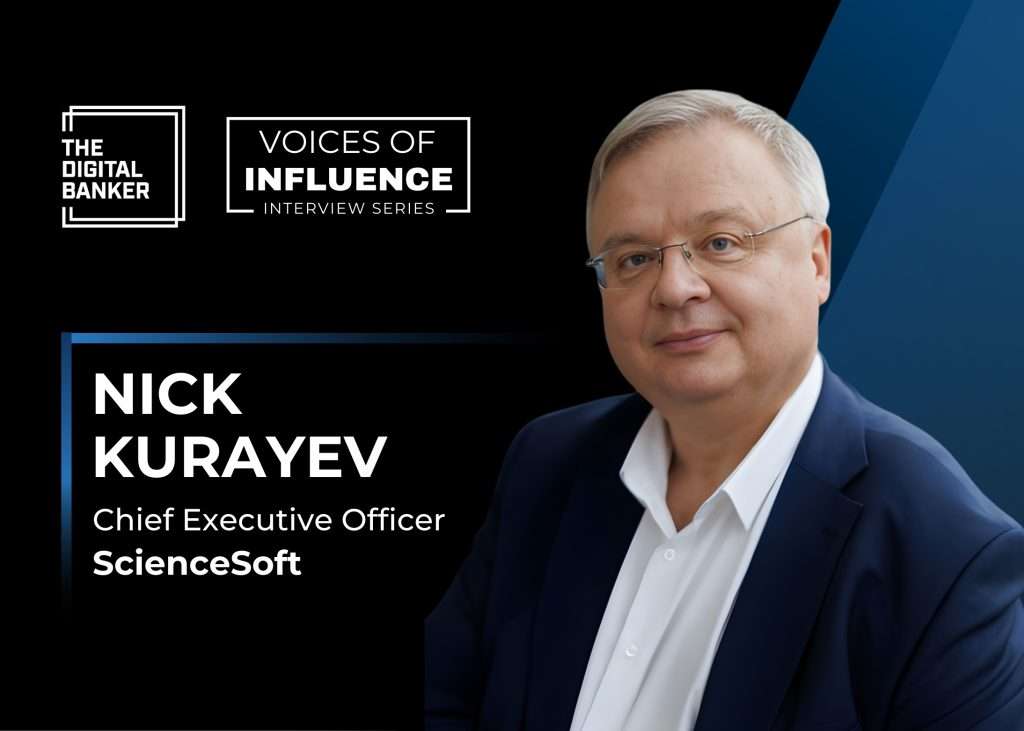
The Digital Banker speaks with Nick Kurayev, CEO of ScienceSoft, about two decades of transformation, scaling with discipline, and why durable demand, not fashion, guides the company’s next phase in artificial intelligence.
When Nick Kurayev reflects on ScienceSoft’s evolution, he frames its most significant decisions not as bets on technology, but as responses to client pressure that exposed structural gaps in the market.
“Both of ScienceSoft’s transformations began when clients presented challenges that required us to move beyond our traditional ways of working,” he says.
The first turning point came in the early 2000s. ScienceSoft had been building niche artificial intelligence products, but Kurayev concluded that the model constrained both impact and growth. “Clients didn’t just need universal tools; they wanted unique solutions to solve very specific operational issues,” he explains. They also wanted a partner willing to share responsibility for outcomes, rather than a vendor that delivered software and exited. The company’s move into custom software engineering coincided with the rise of outsourced development, which Kurayev saw as ‘a durable opportunity’.
From products to partnership
A second overhaul followed in 2015, when ScienceSoft introduced an IT consulting practice alongside its engineering services. Kurayev says he repeatedly observed the same failure pattern across industries. “IT initiatives often fail because strategy and implementation are disconnected.” Enterprises were often forced to choose between consultancies that produced strategy documents and development firms that implemented flawed specifications without challenge. “That gap between paper strategy and working software creates a lot of risk for any serious digital transformation,” he says.
ScienceSoft’s response was to integrate consulting directly into delivery. “We intentionally designed our consulting offering as part of a software engineering service, not as a separate boutique unit,” Kurayev says. Consultants, architects and engineers work together from day one, and remain accountable through delivery. This approach proved particularly valuable in complex enterprise programmes, where advisory input, change planning and risk mitigation were required throughout the lifecycle, not only at inception.
Scaling with discipline
That insistence on accountability has shaped how ScienceSoft scaled through what Kurayev describes as thirty-times growth over two decades. “The hardest challenge was migrating to repeatable, measurable delivery models,” he says. As the organisation expanded, consistency became essential. ScienceSoft introduced formal quality and security frameworks, including ISO certifications, and established an in-house project management office to oversee delivery across regions and industries. Centres of excellence were created to embed shared technical and domain standards across teams.
Cultural change proved slower. “The most difficult shift was moving from a ‘craftsman’ mindset to a ‘partner’ mindset,” Kurayev says. Engineers were encouraged to think beyond technical execution and engage with clients’ business objectives. “Today, it’s normal for ScienceSoft teams to challenge a client’s requirement if it doesn’t clearly help the business, and suggest a stronger alternative.” Embedding that mindset consistently, he adds, required time and discipline.
Technology choices driven by durable demand
As ScienceSoft expanded into areas such as artificial intelligence, big data and the internet of things, the same pragmatism has guided investment decisions. Kurayev describes a two-track approach: internal research to test maturity, and delivery readiness to ensure skills, controls and safeguards are in place. Technologies are moved into the core portfolio only once they demonstrate repeatable value.
Client projects begin with economics. “On client projects, we start with the business case,” he says, asking whether a technology can measurably improve risk, cost, speed or customer engagement. Where returns are clear, adoption accelerates. “In insurance, we’ve already seen AI improve fraud detection accuracy, while big data improve risk prediction.” Less proven areas, such as agentic AI, require feasibility assessments grounded in governance, security and operating cost realities.
Industry focus has been another deliberate constraint. Kurayev recalls early concerns about becoming ‘a mile wide and an inch deep’. ScienceSoft narrowed its priorities to regulated sectors, particularly finance, insurance and healthcare. “Choosing regulated industries wasn’t the easy route,” he says. Slower decision-making and tighter compliance requirements raised the barrier to entry, but also forced depth, allowing expertise to compound into reusable delivery models.
Client longevity remains Kurayev’s preferred measure of success. “How long clients stay with you is more important than how many logos you can list on the website,” he says. Today, 62% of ScienceSoft’s revenue comes from contracts lasting more than two years, supported by what he describes as “competence, delivery credibility, and strategic relevance”.
Kurayev says ScienceSoft aims to become an AI leader in its priority markets. The focus will be on data platforms, large language models and agentic systems, particularly where they support analytics-led use cases such as operational optimisation, customer experience and fraud detection. Expansion will remain disciplined. “We’ll do it with the same pragmatic approach: clear business cases, regulatory awareness, and a focus on production-grade solutions.”