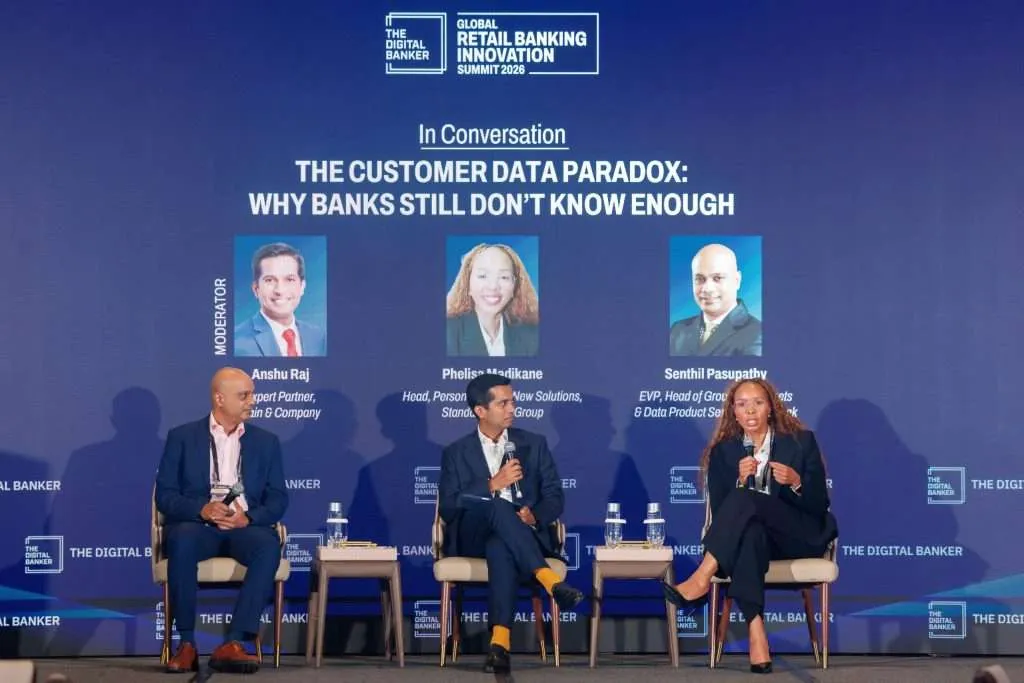
Financial institutions need to connect fragmented customer data and strengthen data governance to deliver more personalised services and make timely decisions, according to Phelisa Madikane, Head of Personalisation and New Solutions at Standard Bank Group, and Senthil Pasupathy, EVP and Head of Group Data Assets and Data Product Services at Maybank.
Speaking at the Global Retail Banking Innovation Summit 2026, Madikane and Pasupathy discussed the challenges banks face in translating customer data into actionable insights, including fragmented systems, data quality, governance and the need to balance personalisation with customer trust. The panel was moderated by Anshu Raaj, Expert Partner at Bain & Company.
Banks hold extensive customer data, yet fragmented systems, inconsistent definitions and limited real-time capabilities often prevent them from using that information to improve customer experiences. “The question is no longer whether we should get more data, but rather are we using our data intelligently,” said Madikane, highlighting the need to extract greater value from information banks already hold.
Data collection must lead to action
For Madikane, the priority lies in turning existing information into timely, relevant interventions. A declined transaction, for example, can help a bank identify a problem and respond before the customer has to seek assistance.
“If I’m in Singapore now and I’m from South Africa and I’m being declined, my expectation for my bank is to use that data to service me in milliseconds immediately,” she said.
Meeting such expectations requires banks to connect information across systems and act on it in real time. Pasupathy argued that the challenge extends beyond technology. “Data is not a technology problem,” he said, pointing to information fragmented across systems designed around individual processes rather than complete customer journeys.
Account opening, for instance, can generate records across onboarding, customer relationship management, credit processing and finance. Inconsistent definitions of measures such as active customers and outstanding balances can make it difficult to establish a consistent view across business functions.
Build a customer view without delay
Developing a 360-degree customer view remains difficult when information spans products, business units and countries. Yet waiting for a complete profile before delivering value can delay improvements to customer service. “We don’t have the luxury of five years of journey to build it,” Pasupathy said.
He advocated treating data as a product, with a defined purpose, roadmap and governance. This approach allows banks to develop reusable data products around specific business needs rather than treating data solely as infrastructure.
Madikane also called for a targeted approach. Rather than attempting to solve every data challenge at once, banks should identify a use case, map the information required across the customer journey and ensure the resulting service remains accurate and seamless. “You don’t try to solve everything at once,” she said.
AI depends on quality and trust
The panellists also discussed the foundations banks need to scale artificial intelligence (AI). While AI can support real-time personalisation, its effectiveness depends on reliable data, consistent definitions and governance embedded in the systems that use it.
Pasupathy stressed that banks must maintain data quality beyond the initial development and testing of an AI application, as models continue to consume information and make decisions after deployment. “So [on] governance, quality is not negotiable here,” he said.
Madikane emphasised that banks must use customer data in ways that reflect customers’ circumstances and needs. Personalisation can improve service when it responds to what a customer is doing, but it can also undermine trust when it feels intrusive or serves the bank’s commercial priorities. “It feels like service, but the minute it’s done to drive your own agenda as a bank, then that’s when I get irritated,” she said.
For banks, the challenge lies in using data and AI to deliver relevant services without making customers feel watched or targeted.
Start with a specific customer problem
Both panellists urged banks to focus on defined customer problems and measurable outcomes rather than pursue data transformation as an end in itself.
Pasupathy recommended identifying a problem with tangible value and developing a data product that can support further applications. Madikane offered a similar principle: “Pick one customer pinpoint and solve for that end to end.” This approach allows banks to address immediate customer needs while building reusable data assets and capabilities for future initiatives.
In his closing remarks, Raj returned to the main challenge: banks generally have sufficient data, but must connect and contextualise it to generate value without compromising customer trust. The priority, therefore, lies not simply in collecting more information, but in using existing data to support accurate, relevant and timely decisions.